
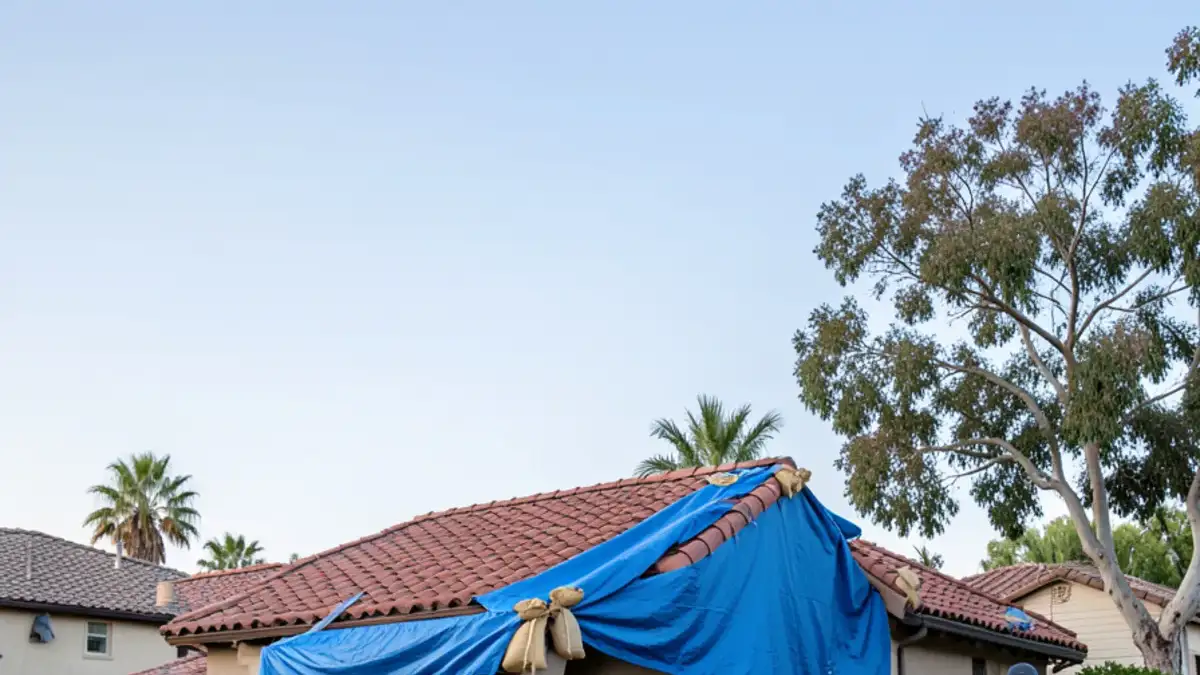
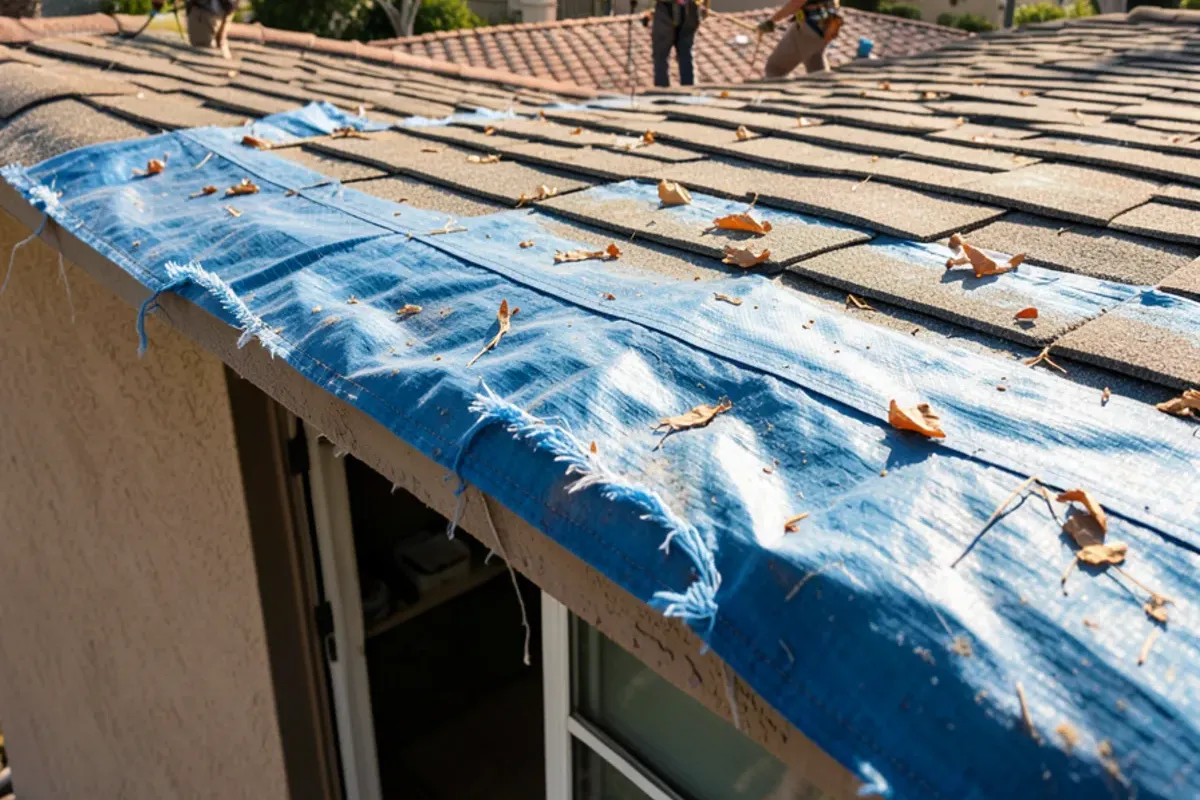
Emergency roof tarping in Rosemead buys you time: a heavy, UV-resistant tarp lapped over the ridge and fastened to battens keeps water off exposed decking until the real repair can be made. It is often the first step of emergency roof repair, and it matters most when the opening is too wide, too wet or too damaged to fix in one visit.
A tarp is not a roof. Done badly, it channels water under its edges, flaps loose in the next gust, or adds nail holes through good shingles. Done well, it sheds rain from the ridge to the eave and comes off later without leaving new damage behind.
When does a roof need a tarp instead of a quick patch?
A tarp is the right call when the damaged area is larger than a few shingles or tiles, when rain is falling or forecast within days, or when the permanent repair has to wait on a tree crew, an adjuster or a permit.
- Decking exposed after wind peeled off shingles or ridge caps.
- A hole or crushed section where a limb landed.
- Broken tile over brittle underlayment that is already letting water through.
- A burned or melted area after fire exposure.
- A leak with no clear source, where a wide cover is safer than guessing at one spot.
For one cracked pipe boot or a single lifted tab, a tarp is overkill. A sealed spot repair is faster and cheaper, and we will tell you that on the phone.
Local roofs add one more reason to cover wide. Point2Homes puts Rosemead's median build year at 1959, so many roofs here sit on aging underlayment, and water from a small opening spreads across brittle felt quickly. Covering several feet beyond the visible damage protects that surrounding area too.
Steps to take before the tarp goes up
- Keep people out from under any sagging ceiling, and turn off power to wet fixtures at the breaker.
- Move furniture, rugs and electronics, then catch drips with buckets or a plastic sheet.
- Photograph the damage indoors and, from the ground only, the roof outside.
- Stay off wet roofs and tile roofs; a fall costs far more than the water damage.
- Call (725) 745-8803 and tell us the roof material, the number of stories and where water is entering.
How quickly can a crew tarp the roof?
We schedule tarping same-day or next-day when crews are free. During a big storm or a Santa Ana wind event, requests stack up across the valley, so you get a realistic window rather than a hopeful one. If no one can reach you today, we say so on the call and tell you when we can.
Distance helps. Our base on Rosemead Blvd sits a few minutes from most nearby neighborhoods, which shortens the drive once a crew opens up.
What our crew does on a tarping call, step by step
A tarping visit finds where water is landing, makes the slope safe and leaves a cover that survives the next gust.
- A ceiling and attic check before anyone goes up, so the cover lands over the real entry point.
- Removal of loose shingles, broken tile and small branches from the damaged slope.
- A reinforced tarp sized to reach well past the damage on every side.
- Battens, sandbags or tie-offs chosen for the roof material, with fasteners kept inside the future repair zone.
- Dated photos and measurements of the opening, handed over with the invoice.
- Trace the wet area in the attic and mark how far moisture has spread.
- Clear debris from the slope and stack any intact tile for reuse.
- Cut the tarp long enough to cross the ridge and hang 3-4 feet down the far slope.
- Roll each edge around a 2x4 batten and run battens with the slope, never across a valley, where they would dam water.
- Lap the upper sheet over the lower wherever two tarps meet, so water cannot enter at the seam.
- Photograph the finished cover and show you what loosening or pooling to watch for.
How we tarp shingle, tile and flat roofs
Composition shingle
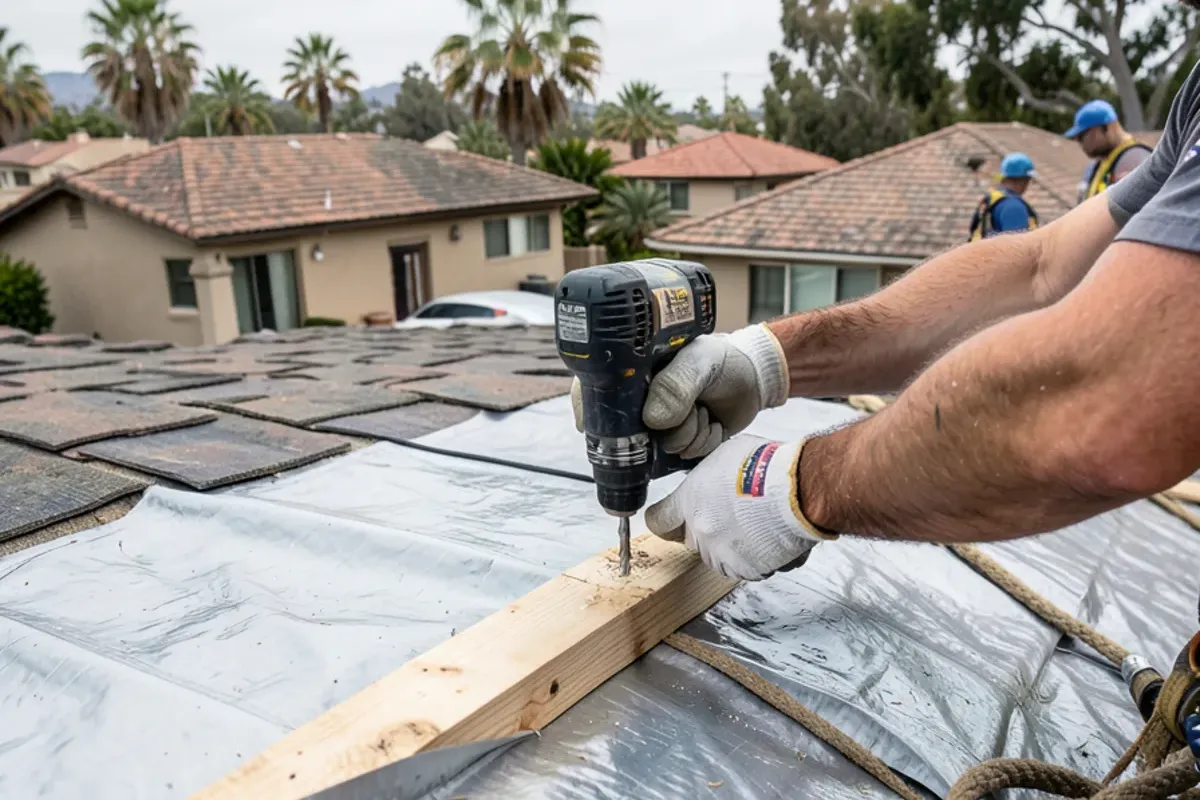
The tarp runs over the ridge and down past the damage so water sheds off its top edge instead of running beneath it. Its edges are rolled around 2x4 battens, and the battens are screwed into the decking, keeping fasteners inside the area that will be repaired whenever possible.
Clay and concrete tile
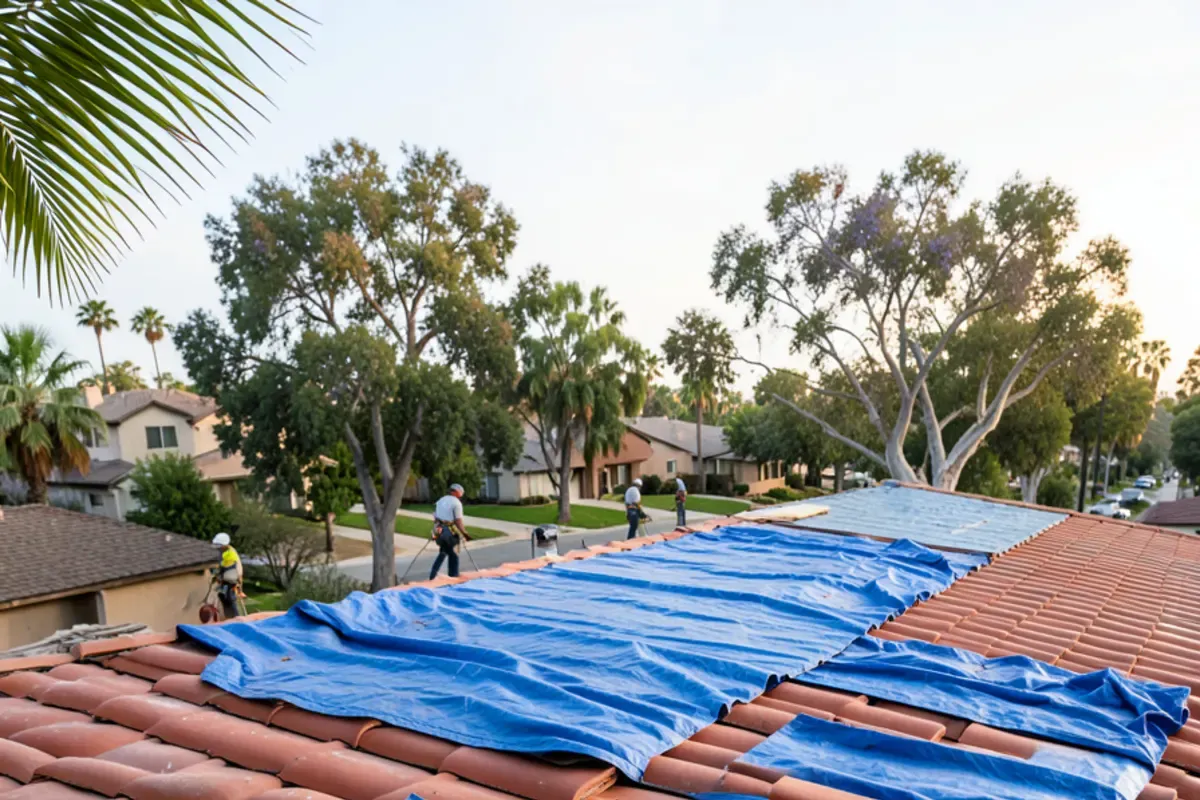
Tile cracks under concentrated weight, so crews step only where tiles are supported or on padded boards, and we avoid screwing through sound tile. The tarp is held by sandbags or weighted battens and tied off at the fascia or framing. Any intact tile we lift to reach the underlayment is stacked and reused.
Flat and low-slope sections
On garages, patio covers and additions, water does not run off a tarp quickly. We clear the drains first, then lap and weight the cover so it cannot pond in the middle.
Need emergency roof tarping help this week?
Tell us what you are seeing. We schedule same-day or next-day visits when crews are free and send photos with a written quote.
- 4.9 from 48 Google reviews
- Based on Rosemead Blvd
- Photos and a written quote before work
What emergency roof tarping in Rosemead costs
A tarp is billed as its own line on the written quote. Its price follows the size of the opening, the material, the height and pitch of the roof, and any debris that has to be cleared first. There is no flat rate, because a small cover on a single-story ranch and a full-slope cover on a two-story tile roof are different jobs.
- Tarp area, and how many battens or sandbags it takes to hold it.
- Roof height, pitch and ladder access.
- Tile handling, including setting aside and reusing intact pieces.
- Debris removal so the cover can lie flat.
Tarp grade matters too: reinforced polyethylene costs more than a thin hardware-store sheet but lasts far longer under valley sun.
Keep the invoice and the photos. Insurers usually ask what was done to prevent further damage and when it was done.
How long a temporary roof cover lasts, and what comes next
A heavy tarp anchored to battens typically holds for weeks, and sunlight is what wears it out. Southern California UV breaks down tarp fabric over a few months, and strong wind loosens edges sooner. Plan the permanent repair inside that window rather than leaving the tarp through a second rainy season.
- We photograph and measure the damage while the tarp goes on.
- Next comes the written repair quote, which lists any decking and permit work as their own lines.
- If wind or rain caused the damage, our pages on wind damage roof repair and storm damage roof repair explain how those repairs are made.
- On repair day the tarp and battens come off, fastener holes are sealed or the decking is replaced, and the new covering goes on.
Do you need a permit or a licensed roofer for a tarp?
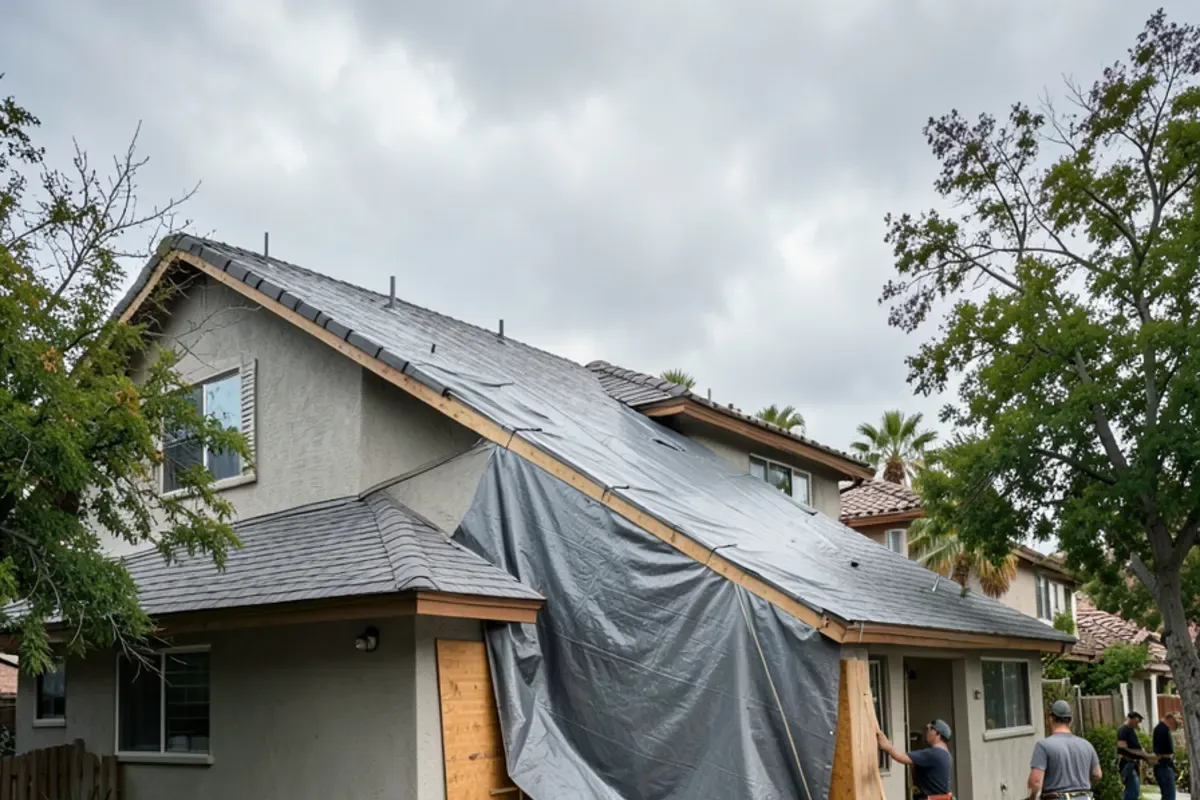
Covering a damaged roof is protective work; any permit attaches to the permanent repair that follows. In Rosemead that permit comes from the city's Building and Safety Division, while unincorporated neighbors such as East San Gabriel go through LA County Public Works Building & Safety.
Licensing can apply sooner. Once labor and materials pass $1,000, California requires a CSLB license, and roof work falls under the C-39 classification. A full-slope cover plus debris removal on a large tile roof can cross that line, so look up the roofer at cslb.ca.gov before the tarp goes on. In foothill Very High fire zones, the repair the tarp is holding for must meet the Class A rules in Chapter 7A.
Why homeowners near Rosemead Blvd ask us to tarp their roofs
- Crews leave from Rosemead Blvd (CA-19), a short drive from most San Gabriel Valley homes.
- Reviewers describe protected, cleaned-up job sites, which matters when work happens above your yard in bad weather.
- On Google, 48 reviews put the rating at 4.9 stars as of November 2026.
- You get photos of the damage before and after tarping, plus a line-by-line quote for the permanent fix.
A tarp is temporary and carries no coverage of its own. The permanent repair does: manufacturer terms depend on the product line, and workmanship terms go into your contract, so get both in writing and ask whether they pass to a future owner.
We tarp roofs across the eastern valley and beyond, including El Monte, South El Monte, Monterey Park and Temple City.
What customers say on Google
4.9★ from 48 Google reviews (checked Nov 2026)
“the roofing crew did an excellent job replacing the roof on my house in rosemead. we had some hail damage after a storm, which another roofer first pointed out. i wanted a second opinion, so i called for a quote, and the response was fast. tanner came by, explained clearly what needed fixing, and was very professional and friendly. …”
“I was very happy with the roofing service I received. I reached out because the skylight in my bathroom was leaking, and Brandon scheduled a visit right away. He actually arrived on time, which is rare these days! …”
“A recent strong wind loosened a shingle on my roof in Rosemead. It took just one call, and Tanner came out the very next day to help. While we talked, I mentioned how thankful I still am for the excellent roofing work the crew did years ago, which has continued to hold up very well. …”
Where we handle emergency roof tarping
- Rosemead
Pre-1960 ranch homes off Garvey Ave often hide brittle felt under layered shingles, so tarps here are cut wide.
- San Marino
Large Mediterranean and Spanish homes with clay tile need sandbag-weighted covers and padded footing so sound tile stays whole.
- Arcadia
Eucalyptus limbs that snap in Santa Ana gusts leave open decking that needs covering the moment the tree crew clears it.
- Sierra Madre
Foothill gusts lift Craftsman roof edges, and Very High fire zone rules shape the permanent repair a tarp holds for.
- Altadena
Homes near the Eaton Fire burn area can sit under covers through long rebuild planning, so UV wear and re-securing matter.
- Monterey Park
Hillside streets with concrete tile roofs call for tarps tied off at the fascia rather than screwed through tile.
- South El Monte
Industrial and commercial flat roofs need their drains cleared before a cover goes down, or the tarp becomes a pond.
- Monrovia
Downslope winds off the foothills can peel a lightly battened tarp, so covers on these slopes get extra battens.
More places we handle emergency roof tarping
Emergency Roof Tarping questions
How long can a roof tarp stay up safely?
Plan on weeks, not seasons. A heavy, UV-resistant tarp anchored to battens can hold for a couple of months in mild weather, but sun and Santa Ana gusts wear down edges and grommets. If a tarp starts flapping, sagging or pooling, call us to re-secure it, and book the permanent repair before the next run of storms.
Can a tarp be secured on a tile roof without breaking tiles?
Yes, with care. Crews walk only where tile is supported, use padded boards where needed, and weight the tarp with sandbags or ballasted battens rather than screwing through sound tile. Already-broken pieces are removed so anchors can reach the deck, and intact tile we lift is stacked for reuse.
Is the tarp cost credited toward the permanent repair?
The tarp is its own line item because it is separate labor and material, and it stays on your paperwork for the insurer. If we also make the permanent repair, both lines appear on the written quote so you can see what each one costs. Ask before work starts how the two are handled on your job.
Is it safe to put a tarp on my own roof?
Only in narrow cases: damage near the eave of a single-story shingle roof, reachable from a ladder in dry weather. Skip wet roofs, tile roofs and anything above one story. Never nail through good shingles along the tarp's edges, because those holes become new leaks once it comes off.
Who takes the tarp down once the roof is fixed?
We do, as part of the permanent repair. The tarp, battens and sandbags come off on repair day and leave with the rest of the job debris. Screw holes in decking that stays are sealed before new underlayment goes down, so the temporary cover leaves nothing behind that could leak later.
Will a tarp stop the leak completely?
It should stop rain from entering through the damaged area. Water already soaked into insulation, framing or drywall can keep dripping or spreading a stain for a day or two. If drips continue after a dry spell, a second entry point may exist, and we look for it on the follow-up visit.