
By Tylzen Spoke Roofing · Published
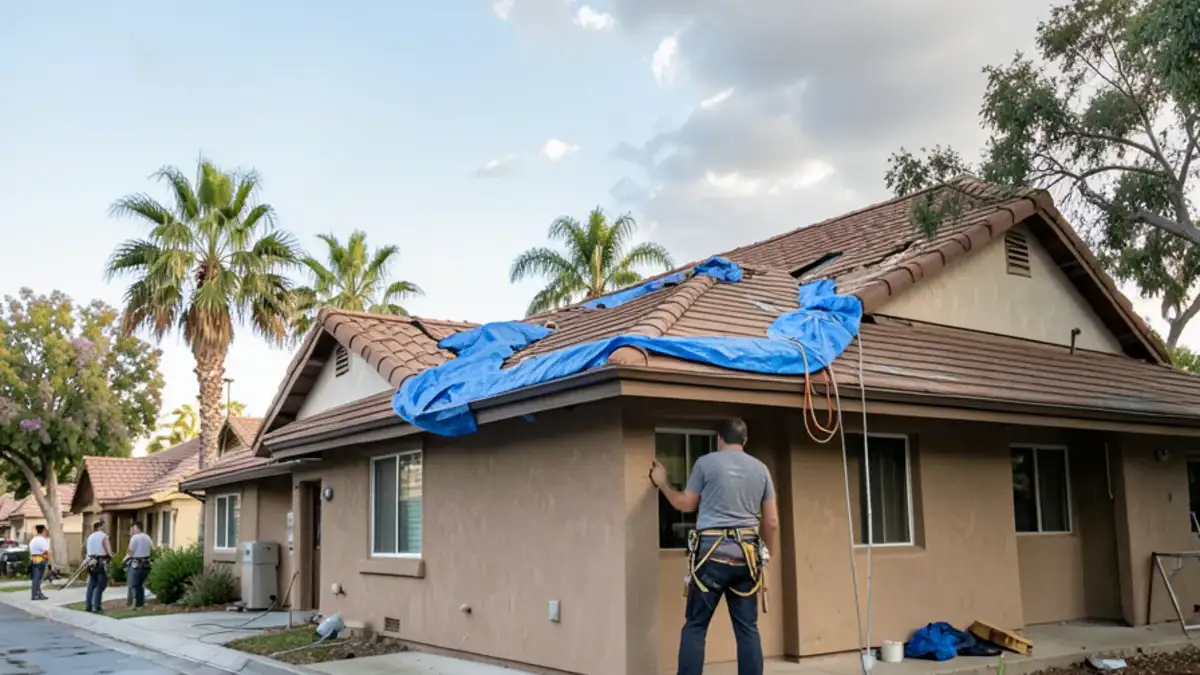
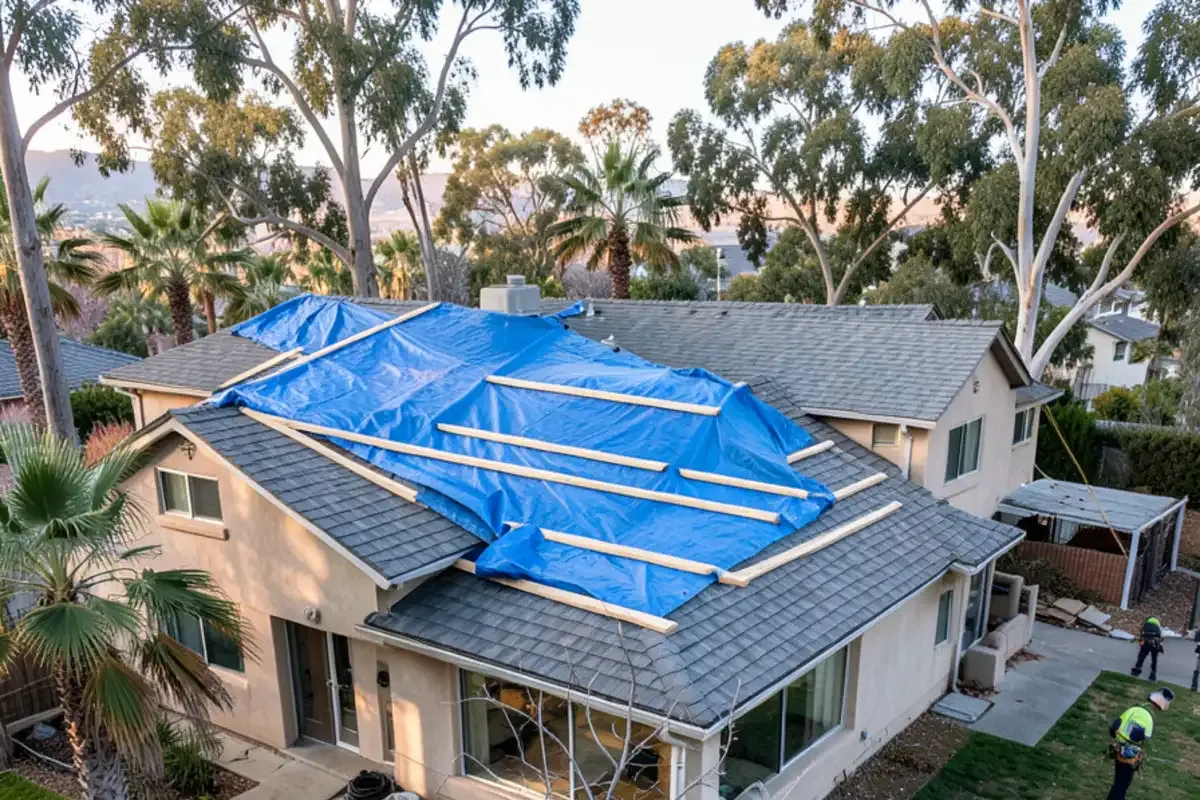
This emergency roof tarping guide starts with the short answer: a roof needs a tarp when there is an opening that rain can reach and the permanent repair cannot happen before the next storm. A good tarp extends well past the damage, laps over the ridge, and is held down with wood battens fastened to the roof deck, not just a few nails through the grommets.
Below we cover how tarps are secured on shingle and tile roofs, how long one can safely stay up, and what drives the cost. The advice reflects what wind and rain do to homes needing roofing in Rosemead and across the San Gabriel Valley.
When does a roof actually need an emergency tarp?
Not every leak calls for a tarp. A cracked pipe boot dripping into a bucket can often be repaired outright on the next dry day. A tarp makes sense when damage is open to the sky or too large to fix before more rain arrives.
- Shingles or tiles torn off by wind, exposing underlayment or bare decking.
- A tree limb that punctured the roof, even after the limb has been removed.
- Fire, ember or heat damage that left holes or melted vents and skylights.
- A forecast of more rain before the permanent repair can be scheduled.
- Several active leaks across one slope, which points to failed underlayment.
Want a roofer to look at it?
Call with your address and what you are seeing. We visit same-day or next-day when crews are free.
- 4.9 from 48 Google reviews
- Based on Rosemead Blvd
- Photos and a written quote before work
How a tarp is secured on a shingle roof
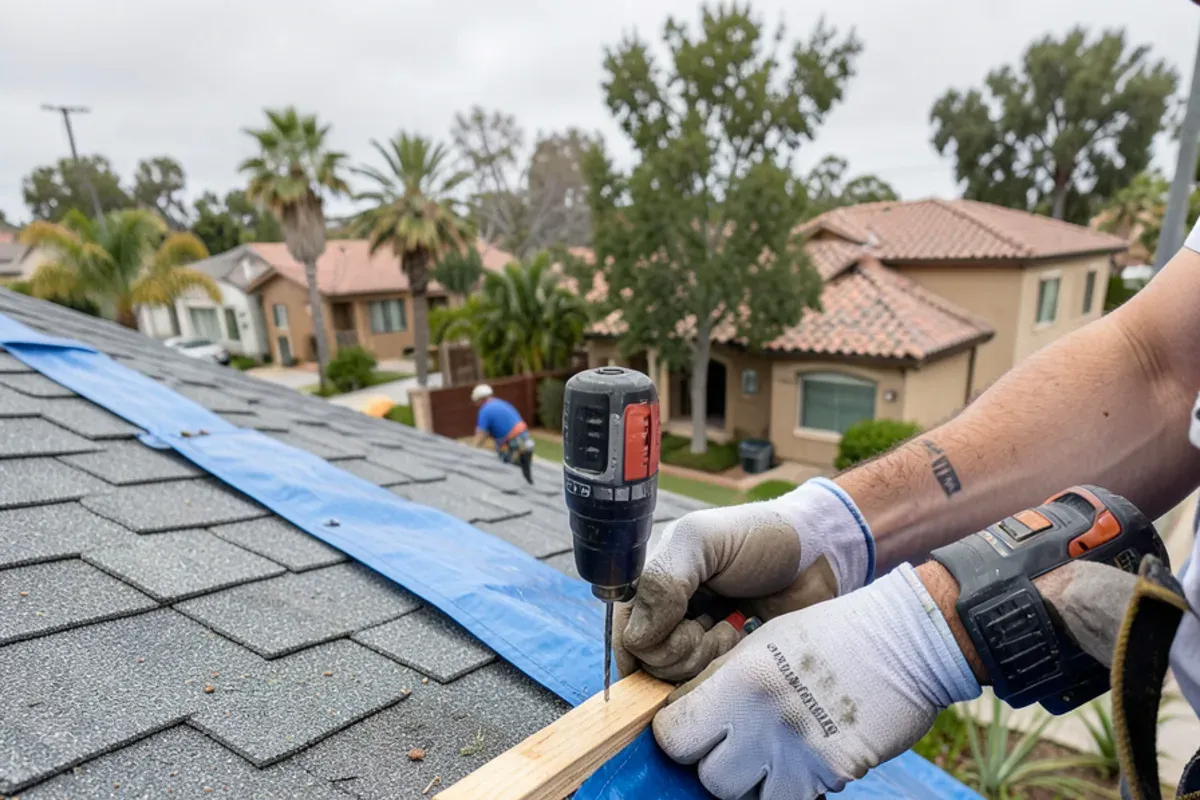
On composition shingle roofs the goal is a tight, flat cover that water runs over, not under. Crews follow roughly this order.
- Clear debris and measure the damaged area, then choose a heavy-duty polyethylene tarp that reaches a few feet past it on every side.
- Run the top edge over the ridge and down the far slope, so rain on the upper roof cannot slip beneath it.
- Roll each edge around a 2x4 batten and screw the batten through the shingles into the deck, keeping fastener holes few and placed where the permanent repair will cover them.
- Add battens across the middle on large tarps so wind cannot lift and balloon the plastic.
- Check that the bottom edge drains onto the roof or into the gutter, not against a wall.
Tarping a tile roof takes a different approach
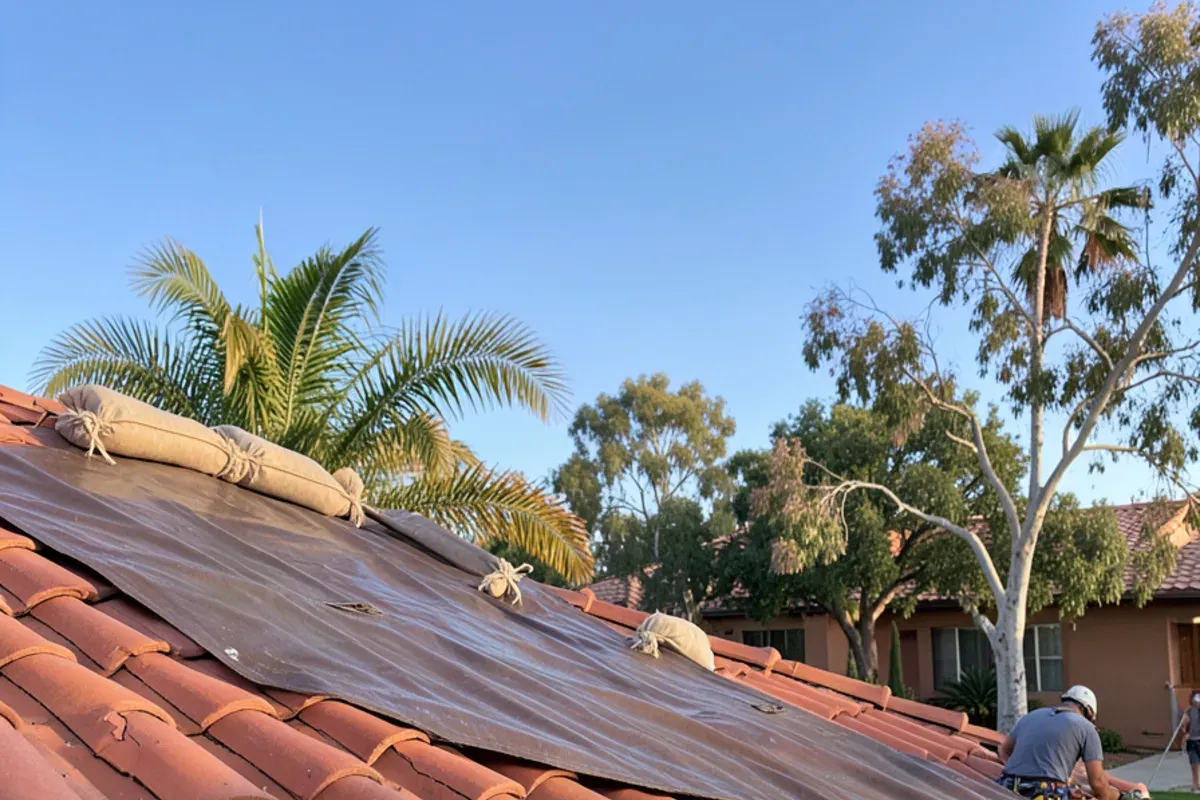
Clay and concrete tile crack under a careless footstep, so a tarp job on tile starts with how the crew moves across the roof. We step on the lower, supported part of each tile or use foam pads, and we avoid the unsupported curve of S-tile and barrel tile.
Fastening is harder too. Screws through tile crack it, so crews either lift a row of tiles to attach battens to the deck and set those tiles aside for reinstallation, or weight the tarp with sandbags tied in pairs over the ridge. When the permanent fix is done, the lifted tiles go back and any broken ones are replaced as part of a tile roof repair.
Can you tarp a flat or low-slope roof?
Yes, but a tarp behaves differently when the roof barely slopes. Rain does not run off plastic laid nearly flat. It collects in every sag, adds weight, and finds the nearest fastener hole. Flat roofs over garages, patio rooms and additions are common on SGV lots, so we see this problem every rainy season.
- Pull the tarp tight and run it toward the drain, scupper or roof edge, never across it, so water leaves the roof instead of pooling on top.
- Weight the field with sandbags rather than screwing battens through an intact membrane, which adds new holes to a roof that only had one.
- Keep the drain or scupper clear of the tarp edge, or the whole roof can flood behind it.
- On a small puncture, a self-adhered patch on a dry, clean surface often outperforms a tarp and stays flatter in wind.
- Where a parapet wall surrounds the roof, lap the tarp up and over it so water cannot slip under the top edge.
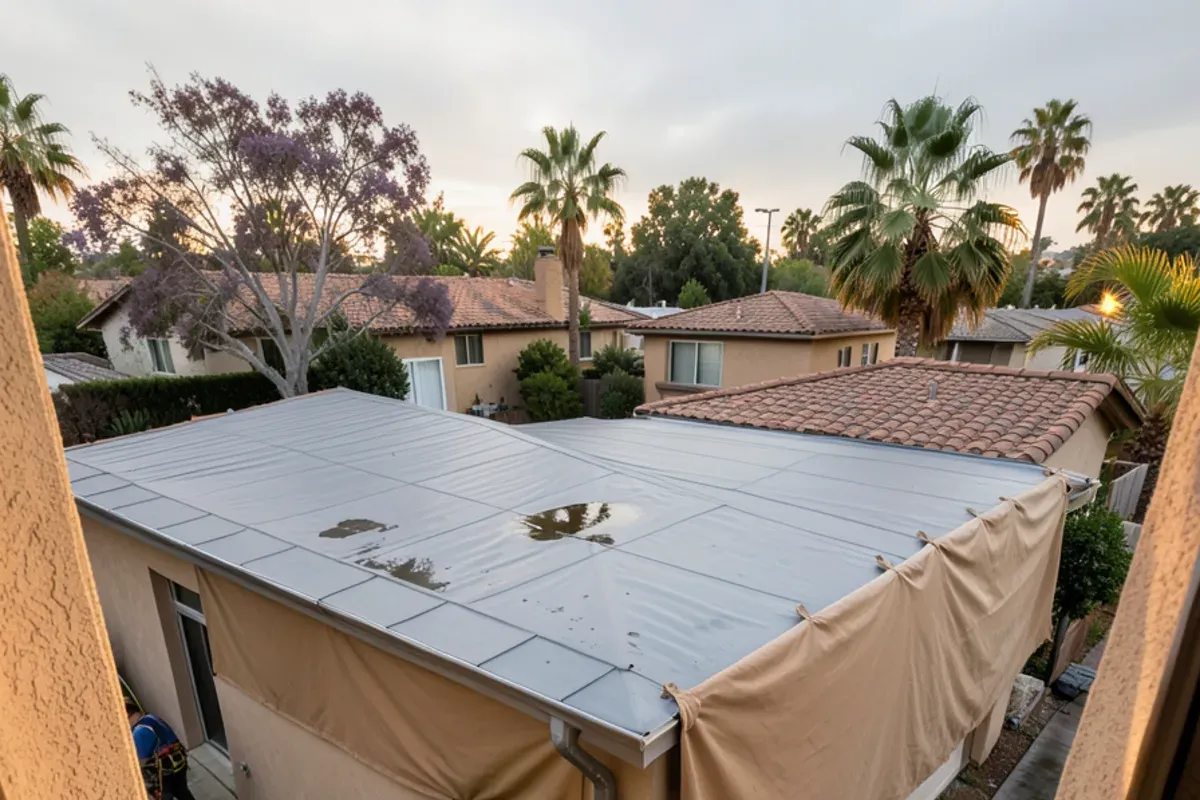
Ponding under or on top of a tarp also hides the real damage. When the cover comes off, we check the membrane around the opening for blisters and soft insulation before pricing the flat roof repair.
Common tarp methods compared
| Method | Works best on | Drawbacks |
|---|---|---|
| Tarp wrapped on battens screwed to the deck | Shingle and flat roofs | Leaves screw holes that the repair must seal |
| Tarp weighted with paired sandbags | Tile roofs and short-term cover | Bags can shift in strong wind and need checking |
| Battens fastened under lifted tile rows | Tile roofs needing longer cover | Slower to install and remove |
| Self-adhered temporary membrane | Small openings on low-slope sections | Sticks poorly in wet or dusty conditions |
How long can a tarp stay on a roof?
Think in weeks, not seasons. Polyethylene breaks down in strong sun, and a tarp that sits through a Southern California summer often turns brittle and starts to shred along the battens. Wind is the other threat: Santa Ana and downslope events peak between October and March, the same months as the rain.
Walk around the house after every windy day and look for flapping corners, a sagging middle that holds water, or sandbags that slid toward the gutter. If anything moved, call to have it reset before the next storm. Most importantly, book the permanent repair as soon as the roof is dry.
From tarp to permanent repair, step by step
Taking a tarp off is part of the repair, and the order matters because the roof is exposed again the moment the plastic comes up.
- Pick a dry window with no rain in the forecast for the length of the job.
- Photograph the tarp in place, then the damage underneath, so the claim file shows both stages.
- Remove battens and sandbags, and mark every fastener hole the tarp left behind.
- Probe the deck around the opening and replace any soft or delaminated sheathing.
- Install new underlayment, flashing and roofing, sealing or replacing the shingles the battens went through, and reset any tiles that were lifted.
- Haul away the old tarp, battens and debris, then check the attic for drips on the next rain.
What affects the cost of a roof tarp?
Tarp pricing depends on the size of the damaged area, roof pitch and height, the roofing material, and whether debris such as a broken limb must be cleared first. Two-story and steep roofs need more safety setup, and tile adds time for careful access.
Most homeowners policies expect you to prevent further damage, so a tarp is often treated as a reimbursable mitigation cost. Ask for an itemized invoice and keep photos of the damage before and after it was covered. Your adjuster makes the final call on coverage, and our emergency roof tarping service includes the photos you will need.
What our crews notice under tarps in Temple City and Rosemead
Homeowner-installed tarps usually fail in predictable ways. The top edge stops short of the ridge, so water runs down the upper roof and straight under the plastic. Nails through grommets pull loose. A tarp left up from one winter to the next turns to confetti and lets the next storm in.
Neighborhoods with big, older trees see the most punctures. Mature canopies over homes in Temple City, Arcadia and San Gabriel drop limbs in wind, and those holes often need decking replaced before the roof is closed up. We note any soft sheathing under a tarp and price it as its own line, separate from the roof covering.
When we skip the tarp and repair right away
A tarp is an extra cost and an extra trip, so it is not always the right call. If the opening is small, the deck is dry and the forecast gives us a clear day, it is often cheaper to make the permanent repair on the first visit. The trade-off is timing: materials such as matching tile or a specific flashing may not be on hand, and waiting for them with the roof open is not an option. We explain which path fits on the call and price both if needed.
Cover the damage now, plan the repair next
A tarp is a bridge, not a fix. It should be fastened well enough to ride out wind, lapped so water cannot sneak beneath, and replaced by a permanent repair within weeks. For damage beyond one opening, see our storm damage roof repair page. If your roof is open to the weather, phone (725) 745-8803. Visits are same-day or next-day when crews are free, and you will hear on the call if today is not possible.
Questions readers ask
Will homeowners insurance pay for an emergency tarp?
Often, when the tarp protects the house from further damage after a covered loss like a windstorm or a tree strike. Policies differ, so keep the itemized invoice and your photos and submit them with the claim. A tarp over a roof that leaked from old age may not be reimbursed.
Can a tarp go on at night or during rain?
Sometimes, but crew safety comes first. In heavy rain, lightning or strong wind, a roof is too dangerous to walk, and we may contain the leak from the attic until conditions ease. Once the roof is safe, the tarp goes on and is fastened properly.
Does tarping damage my roof?
A careful install leaves a handful of fastener holes placed where the permanent repair will cover them, or no holes at all when sandbags are used on tile. The bigger risk is a loose tarp that rubs granules off shingles or lets water pool. Proper battens prevent both.
What size tarp does a damaged roof need?
Larger than most people expect. The tarp should reach at least 3 to 4 feet past the damage on each side and run over the ridge onto the opposite slope. An 8 by 10 foot opening near the ridge can need a tarp twice that size. Measure from the ground or attic if you can, and tell us the dimensions when you call so the right size is on the truck.
Sources
Written by Tylzen Spoke Roofing
A roofing contractor on Rosemead Blvd (CA-19) in Rosemead, working on shingle, tile, metal and flat roofs across the San Gabriel Valley. This guide reflects what our crews check on local roofs. Questions about your roof? Call (725) 745-8803.