
By Tylzen Spoke Roofing · Published
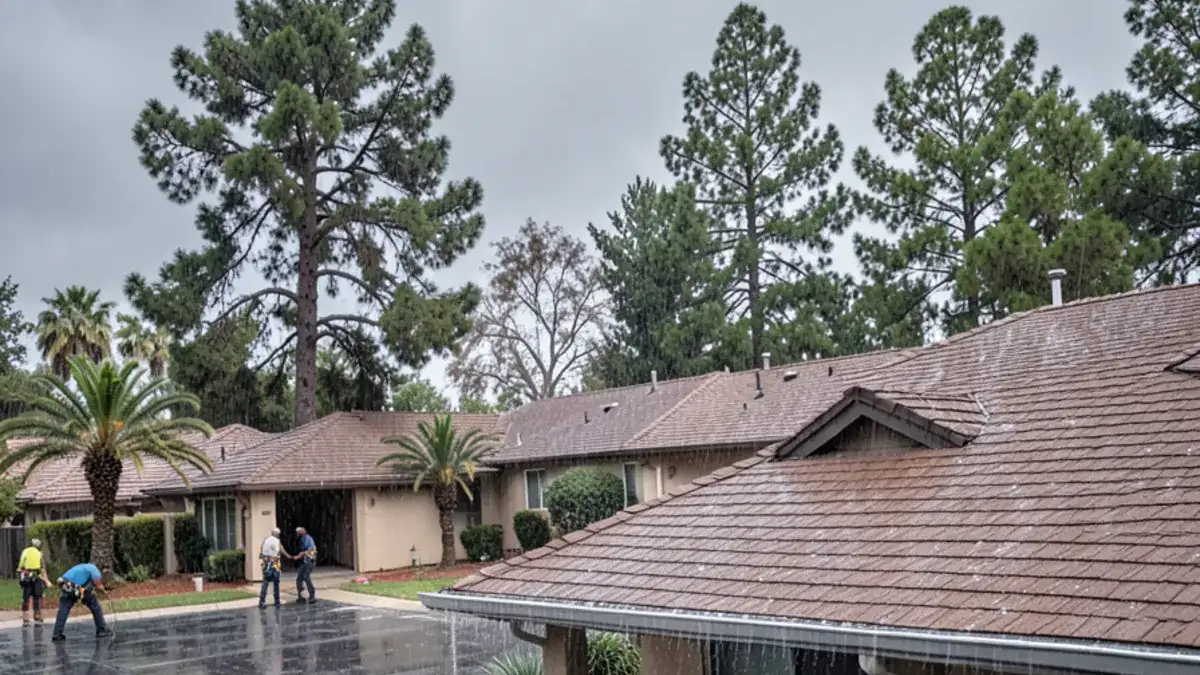
Gutters overflowing in heavy rain usually comes down to one of five causes: a clog in the gutter or downspout, gutters pitched flat or backward, too few or too small downspouts, a gutter that is undersized for the roof area feeding it, or a roof valley that shoots water past the gutter lip. Watching where the overflow happens during a storm tells you which one you have.
Most fixes are simple once the cause is clear. This guide covers how to diagnose each one and when gutter repair and cleaning solves it versus when the drainage layout needs to change.
Why do gutters overflow during a downpour?
A gutter is a small channel asked to carry a lot of water in a short time. Southern California storms are not long, but they can be intense, and a system that copes with drizzle can fail in a heavy burst.
- Clogs: leaves, needles, blossoms and shingle granules settle at outlets and in low spots.
- Wrong pitch: sagging hangers leave sections flat or tilted away from the downspout.
- Downspout limits: one outlet asked to drain too long a run, or a 2x3-inch downspout where a 3x4 is needed.
- Undersized gutter: a large or steep roof section draining into a small profile.
- Valley overshoot: water from two slopes merges and moves too fast for the gutter to catch.
- Blocked underground drains that back up into the downspout.

Want a roofer to look at it?
Call with your address and what you are seeing. We visit same-day or next-day when crews are free.
- 4.9 from 48 Google reviews
- Based on Rosemead Blvd
- Photos and a written quote before work
Is your gutter too small for the roof above it?
Gutter sizing depends on three things: the area of roof that drains into it, the pitch of that roof, and how hard it rains locally. Steeper roofs shed water faster, so they act larger than their footprint. Sheet metal standards such as those from SMACNA use those inputs to pick a gutter and downspout size.
In practice, standard 5-inch K-style gutters suit many single-story homes. A 6-inch profile is worth considering for large roof planes, two-story roofs draining onto a single run, and eaves that collect water from a valley. Upgrading downspouts from 2x3 to 3x4 inches, or adding one more outlet, often fixes overflow without replacing the whole gutter.
How much water reaches one gutter in a hard storm?
The numbers explain why a gutter that copes all winter can still spill in one cloudburst. One inch of rain falling on 1,000 square feet of roof adds up to about 623 gallons. If a 600-square-foot roof plane drains to a single downspout and a storm cell drops an inch in an hour, that one outlet has to pass roughly 370 gallons, or about 6 gallons a minute, the whole time.
- A 3x4-inch downspout has twice the opening of a 2x3, 12 square inches against 6, so upsizing one outlet can double what that corner drains.
- A second downspout on a long run halves the distance water travels and the load on each outlet.
- Steep roofs count as more area in sizing tables because wind-driven rain strikes the slope, which is why two-story roofs overload gutters sized by footprint.
- A valley can deliver the water of two roof planes to a few feet of gutter, concentrating the load where the overflow appears.
Sizing tables from sheet metal standards build these factors in using a local design rainfall rate. We measure the roof planes on site and check each outlet against them rather than guessing from the street.
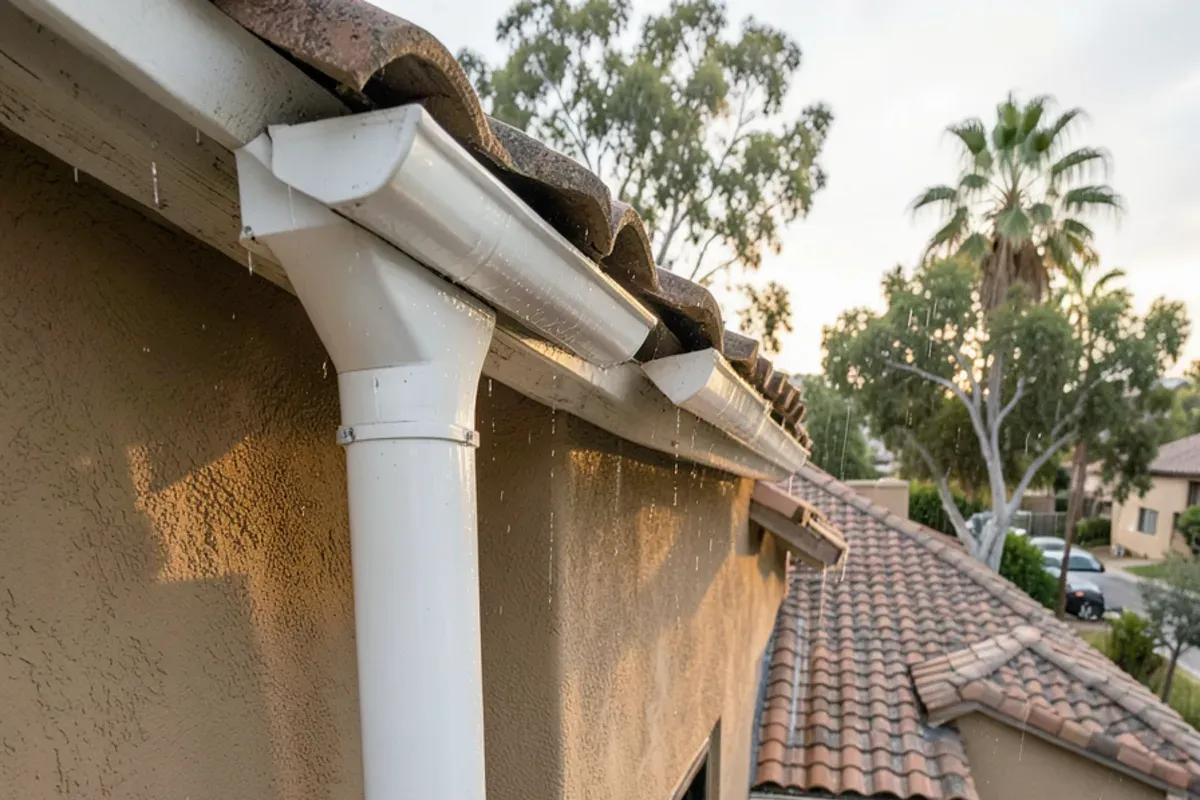
Checking gutter pitch with a level and a hose
A gutter needs a slight fall toward each downspout. A common target is about 1/4 inch of drop for every 10 feet of run, enough to move water without being visible from the street.
- On a dry day, from a stable ladder, place a level on the gutter's front edge in a few spots.
- Look for sections that are dead flat or tilt away from the outlet.
- Run a hose at the high end of the gutter and watch whether water reaches the downspout or pools.
- Check hangers in any low area; loose hangers usually mean the fascia behind them is soft.
- Note standing water or a line of dirt inside the gutter, a sign water sits after storms.
When roof valleys overshoot the gutter
A valley gathers water from two roof slopes into one narrow channel. In a hard storm, that stream reaches the eave with enough speed to jump right over the gutter, soaking the ground and the wall below one corner.
- A splash guard or diverter at the gutter's outer edge catches the stream.
- A downspout placed close to the valley outlet shortens the distance water must travel.
- A larger gutter at that corner adds capacity where it is needed most.
- On tile roofs, the valley metal end and the gutter height need to line up so water lands inside.

Matching the symptom to the fix
| What you see | Likely cause | Typical fix |
|---|---|---|
| Overflow at one spot along a run | Clog or a low section | Clean and re-hang to proper pitch |
| Overflow right at the downspout | Blocked or undersized downspout | Clear, upsize to 3x4 or add an outlet |
| Water shooting past an inside corner | Valley overshoot | Splash guard, nearby downspout or larger gutter |
| Overflow along the whole length in hard rain | Gutter too small for the roof | Upsize gutter or add downspouts |
| Water backing up out of a downspout | Crushed or clogged underground drain | Clear the line or redirect to a surface outlet |
| Water running behind the gutter | Missing drip edge or gutter set too low | Add drip edge or apron and reset gutter |
What we see during San Gabriel Valley downpours
Weatherblaze data shows February as Rosemead's wettest month, averaging about 86 mm, inside a rainy season that runs roughly November to March. Most of it arrives in short, heavy bursts after months of dry weather, which is the worst pattern for gutters.
- Summer debris and dust settle into a paste that holds water at outlets.
- Downspouts tied into old clay or thin plastic underground pipes that have cracked or filled with roots.
- Additions and patio covers draining onto the main gutter, doubling the load at one run.
- In Arcadia and other neighborhoods under tall pines and oaks, needles mat across gutter outlets within weeks.
Fixes we weigh against each other
Re-hanging a sagging run costs far less than new gutters, but if the fascia behind it is soft, new hangers will pull out again by the next winter, so we probe the wood before choosing. Adding a downspout is the cheapest capacity upgrade, yet every new outlet needs somewhere safe to send its water. On a tight side yard that can mean an underground line, which brings its own upkeep.
A splash guard costs little and stops most valley overshoot, though in the hardest bursts a larger gutter at that corner works better. Guards cut down on clogs, but some styles shed water in a downpour. We usually fix pitch and outlets first, watch one storm, and only then decide whether guards or a bigger profile are worth the money.
For homes across the valley, including roofing in Rosemead, the fix is often a mix of cleaning, re-pitching and one or two extra downspouts and drainage changes rather than all-new gutters.
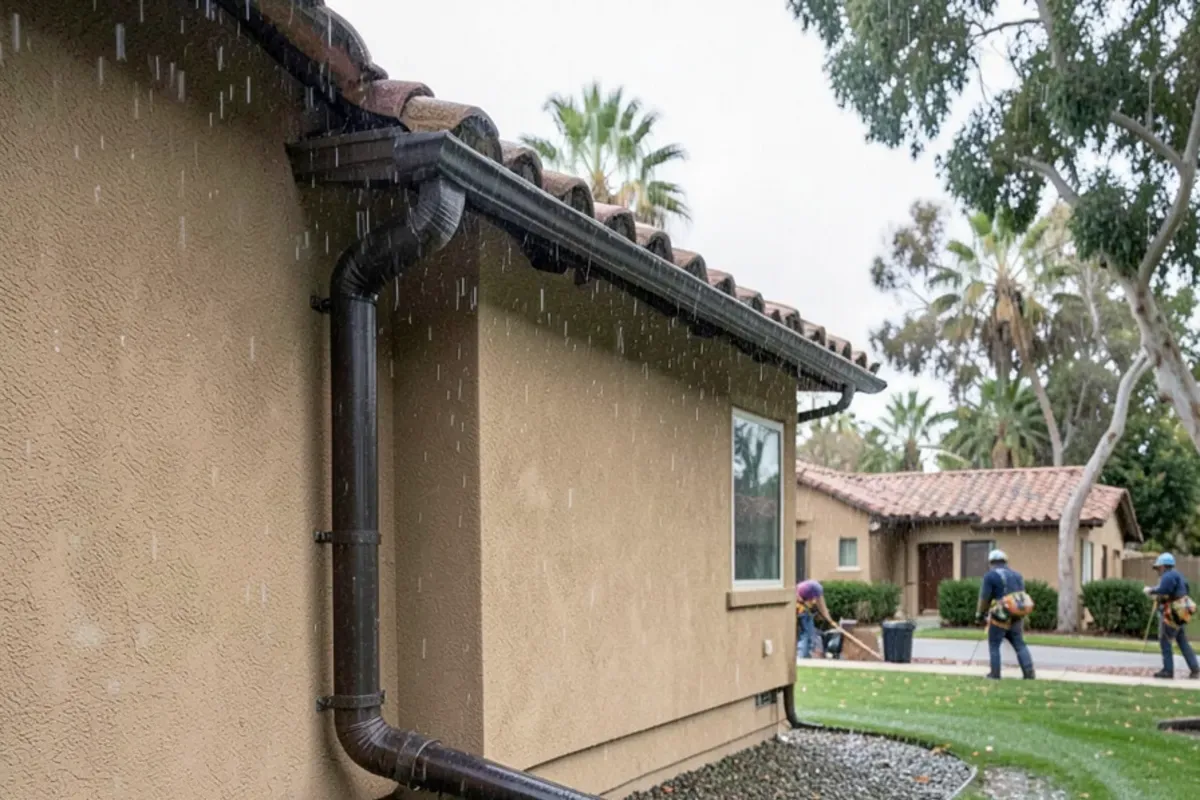
When overflow has already caused damage
Look along the eave after a storm. Peeling paint, dark streaks on the stucco and a soft fascia board all show where water has been spilling, and they often need soffit and fascia repair before a new or re-hung gutter can hold.
Repeated overflow soaks fascia boards, stains stucco, erodes soil at the foundation and can push water under the first course of roofing. If gutters sag, paint is peeling along the eave, or water pools against the house, the repair should include the wood and drainage, not just the gutter. Call (725) 745-8803 or request a quote, and we will trace where the water goes and give you a written, photo-documented plan.
Questions readers ask
Do gutter guards stop overflow in heavy rain?
They stop debris clogs, which cause much overflow, but they cannot add capacity. Some guard styles also shed part of the water past the gutter in very hard rain. If the gutter is undersized or poorly pitched, a guard will not solve it. Fix pitch and outlets first, then add guards where trees are the problem.
Why do my gutters overflow even when they are clean?
Clean gutters that still overflow usually point to pitch, capacity or a valley. A flat section holds water until it spills, a single downspout may be draining too long a run, or a valley may be shooting water past the corner. A hose test on a dry day helps locate which one.
Can overflowing gutters cause roof leaks?
Yes. When water backs up in a full gutter, it can wick behind the gutter and under the roof edge, soaking fascia and the roof deck at the eave. Missing drip edge makes this more likely. Stains on soffits or rot along the eave are signs it has been happening.
Should I add a downspout or install bigger gutters?
Try the downspout first in most cases. An extra outlet, or an upgrade from 2x3 to 3x4 inches, often solves overflow on a 5-inch gutter for a fraction of the cost of new gutters. Bigger gutters make sense when the whole run spills in hard rain even with good pitch and clear outlets, or when a large two-story roof drains onto a single-story eave.
Is a little overflow in an extreme cloudburst normal?
Yes, a brief spill at the worst moment of a rare storm is not always a defect. Gutters are sized to a design rainfall rate, and an unusual cell can exceed it for a few minutes. Overflow in ordinary storms, at the same corner every time, or water running behind the gutter is a sign of a fixable problem worth correcting before the wettest weeks of February.
Sources
Written by Tylzen Spoke Roofing
A roofing contractor on Rosemead Blvd (CA-19) in Rosemead, working on shingle, tile, metal and flat roofs across the San Gabriel Valley. This guide reflects what our crews check on local roofs. Questions about your roof? Call (725) 745-8803.