
By Tylzen Spoke Roofing · Published
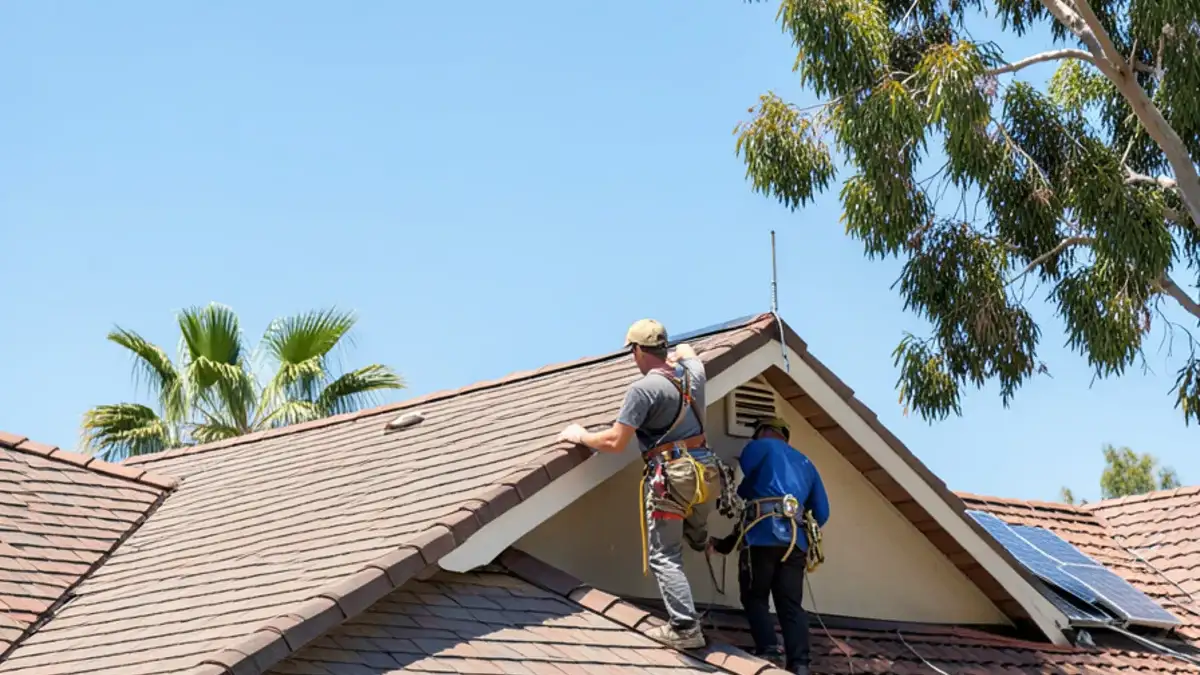
In the ridge vent vs attic fan debate, a ridge vent wins on most gable roofs: it is passive, silent, has no motor to fail, and pulls air evenly along the whole peak as long as the soffits supply enough intake. Electric and solar attic fans make sense on roofs with little ridge, such as hips, or on attics with pockets that passive vents cannot reach. Whichever you choose, it only works with enough intake at the eaves.
Each option also handles heat, wind-driven rain and fire-zone rules differently, and those differences matter in the San Gabriel Valley.
Ridge vents, attic fans and solar vents side by side
| Factor | Ridge vent | Electric attic fan | Solar attic fan |
|---|---|---|---|
| How it moves air | Passive: rising heat plus wind across the peak | Motor pulls air out through a roof or gable opening | Motor driven by its own small solar panel |
| Running cost | None | Electricity while running | None |
| Suits | Gable roofs with long ridges | Hips and complex roofs with little ridge | Same as electric, on a slope with good sun |
| At night | Keeps working, slowly | Runs on its thermostat | Little or nothing unless the model has backup power |
| Moving parts | None | Motor, thermostat, wiring | Motor and panel |
| Main risk | Weak without enough intake | Can pull cooled air out of the house through ceiling gaps | Same as electric, with less airflow on cloudy days |
| Noise | Silent | Audible hum | Usually quiet |
Want a roofer to look at it?
Call with your address and what you are seeing. We visit same-day or next-day when crews are free.
- 4.9 from 48 Google reviews
- Based on Rosemead Blvd
- Photos and a written quote before work
How does a ridge vent work, and where does it fall short?
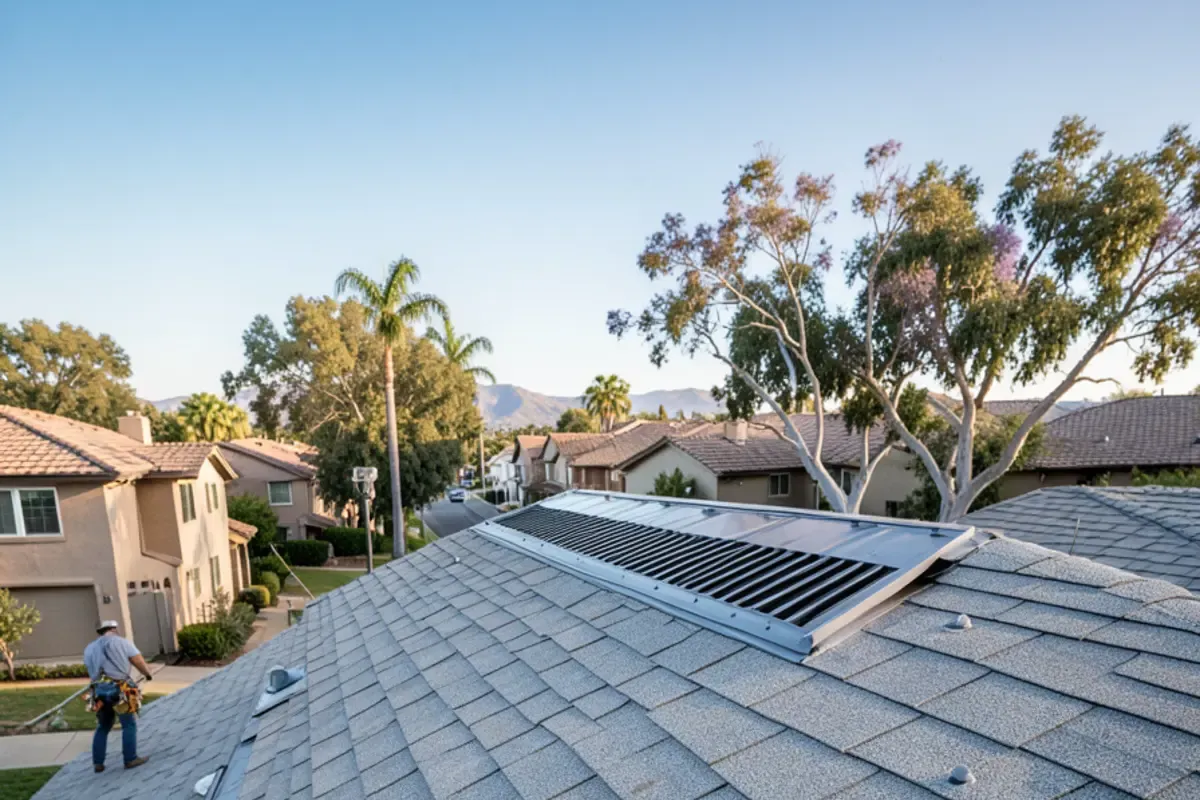
A ridge vent is a narrow slot cut along the peak, covered by a vented cap that sheds rain while letting air out. Heat collects at the top of the attic and escapes along the full length of the slot, while cooler air enters at the soffits. Wind blowing across the ridge adds a little suction.
It falls short when the ridge is short. Many SGV ranch homes have hip roofs where four slopes meet at a brief peak, leaving only a few feet to vent. Tile roofs add a step, since the ridge has to be rebuilt with a vented system under the tile caps. A ridge vent also cannot help an attic pocket that never reaches the main peak.
Off-ridge and box vents
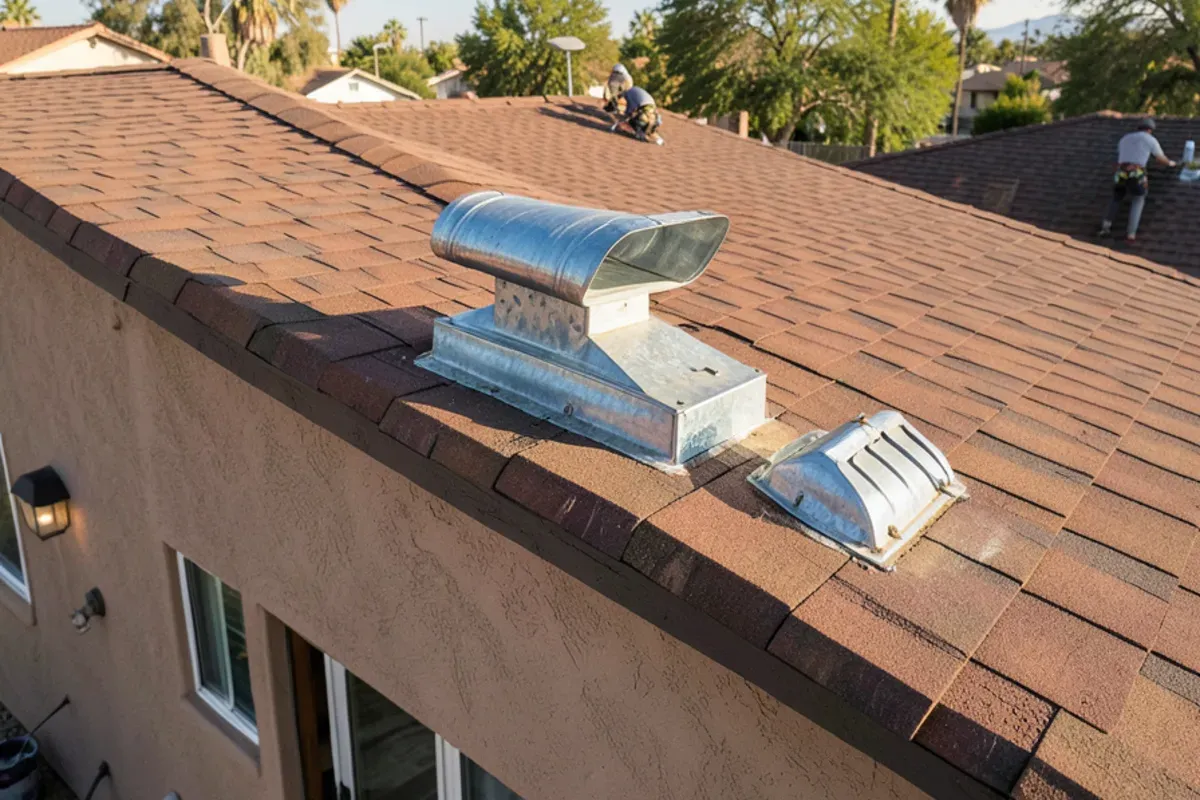
Where ridge length runs out, low-profile box vents or off-ridge vents near the top of each slope add exhaust without motors. They are the usual partner to a short ridge vent on a hip roof.
When does a powered or solar attic fan make sense?
A fan forces airflow instead of waiting for it, so it clears heat faster on a still afternoon. That is useful in three situations:
- The roof has little usable ridge and limited room for passive exhaust.
- A dead-air pocket, such as the attic over a second-story addition, sits beyond the reach of passive vents.
- A gable-end attic relies on gable vents alone, and a gable-mounted fan can boost the existing opening.
The trade-off is depressurization. When a fan moves more air than the soffits can supply, it makes up the difference from the house, up through recessed lights, the attic hatch and gaps around plumbing. That is air your air conditioner already paid to cool. Fans also short-circuit when nearby passive vents let them pull outside air from the roof instead of from the eaves.

Where do turbine, gable and box vents fit in?
Ridge vents and fans get most of the attention, but many SGV attics already have one of three older exhaust types. Each still has a place:
- Turbine vents: the spinning domes sometimes called whirlybirds. Wind turns the head and pulls air out, so they move more than a static vent in a breeze and little more than one on a still afternoon. Worn bearings squeak or seize, and a stuck turbine is just an expensive box vent.
- Gable vents: louvered openings high in the end walls of a gable attic. They exhaust well when wind crosses the house, but paired with a ridge vent they can trade air with each other near the peak and leave the lower attic stagnant.
- Static box vents: square, low-profile vents near the top of the slope. They are simple, have nothing to fail, and work in groups. On hip roofs they often carry most of the exhaust.
The rule that ties them together is the same one that governs ridge vents and fans: one exhaust type per attic space where possible, sized against the intake. Mixed systems are where we find short-circuiting most often.
Fire zones, rain and permits
In CAL FIRE Very High Fire Hazard Severity Zones, including foothill parts of Sierra Madre, Monrovia, Bradbury and Duarte, Chapter 7A of the California Building Code requires ember-resistant vents screened with mesh sized from 1/16 to 1/8 inch. Ridge vents, off-ridge vents and fans all come in compliant versions, but not every product on the shelf qualifies, so check before buying.
Ridge vents with an external baffle shed wind-driven rain better than flat-topped caps, and fans need a well-flashed curb like any other roof penetration. A reroof is the cleanest time to add vents, because the roofing is already off. Some cities want a permit for new roof penetrations or for hardwiring a fan, so ask your building department.
What we recommend most often on SGV roofs
On the single-story gable homes common in El Monte and Rosemead, the answer is usually simple: restore the soffit intake and add a ridge vent at the next reroof. Plenty of those attics already have enough exhaust on paper; what they lack is air coming in low to feed it.
Hip roofs and the larger two-story homes in Temple City more often get a mix: a short ridge vent plus off-ridge vents, and sometimes a solar fan over a pocket the passive vents cannot reach. We size the exhaust against the intake instead of adding fans by default, and we photograph the attic so you can see the reasoning.
We also come across old electric attic fans that have quietly stopped working. A failed thermostat either never switches the fan on or never switches it off, and a dead fan is just a hole in the roof that still has to stay sealed.
The fan trade-off we check before recommending one
Many San Gabriel Valley homes have a furnace or water heater in the attic, and that changes the fan question. A powered fan that lowers attic air pressure can pull exhaust gases back down a gas appliance flue instead of letting them rise out, which is a safety problem, not just an efficiency one. Before suggesting any fan, we look for gas appliances in the attic and how their flues are vented.
Intake is the other half. Restoring painted-over or blocked soffits often does more than adding a fan, and it costs less to run. Where the soffit boards themselves are rotted or have no vents at all, soffit and fascia repair can add intake as part of the same visit.
Pick the vent that fits the roof, not the trend
Ridge vents suit long gable ridges, off-ridge vents fill in on hips, and fans solve specific problems when the intake can support them. Start at the soffits, match exhaust to intake, and keep powered and passive exhaust off the same attic space. Our attic ventilation visits include measurements and a written plan, and for heat problems beyond venting, read our guide to hot upstairs rooms. Call (725) 745-8803 to set up an attic check.
Questions readers ask
Can a ridge vent and an attic fan share the same roof?
Not over the same attic space. The fan tends to draw air in through the nearby ridge vent instead of from the soffits, so the lower attic stays hot and rain can be pulled in at the ridge during wind. If a fan is the right tool, the ridge vent over that area should be closed off or left out.
Do solar attic fans need a permit?
It depends on the city. A self-contained solar fan needs no house wiring, but it still cuts a new hole in the roof, and some building departments want that on a permit. Hardwired electric fans add electrical work. Check with your city, or with LA County Public Works if you live in an unincorporated area.
How much attic ventilation does a typical house need?
The usual code ratio is 1:150, one unit of net free vent area for each 150 units of attic floor, relaxed to 1:300 when vents are balanced high and low and certain conditions are met. Vent packaging lists net free area, so the math is straightforward. Your building department confirms what applies to your home.
How many box vents does a hip roof need?
Work it out from the attic size and each vent's label. A 1,500 square foot attic at the 1:300 ratio needs about 720 square inches of net free area in total, with roughly half, around 360 square inches, as exhaust near the top. If each box vent lists 50 square inches, that is about 7 vents, spread across the slopes. Intake at the soffits should match or exceed that.
Sources
Written by Tylzen Spoke Roofing
A roofing contractor on Rosemead Blvd (CA-19) in Rosemead, working on shingle, tile, metal and flat roofs across the San Gabriel Valley. This guide reflects what our crews check on local roofs. Questions about your roof? Call (725) 745-8803.